From passive receiver to active creator: why ActiveFloor works
By Ole Henrik Hansen, PhD in Didactics, Professor of Education
the connection between the body and learning
For many years, learning has been understood as something that could be “poured into” children – as if knowledge could be transferred one-way from adult to child and then simply stay there. Ole Henrik Hansen points out that this view of learning is both too narrow and overly optimistic.
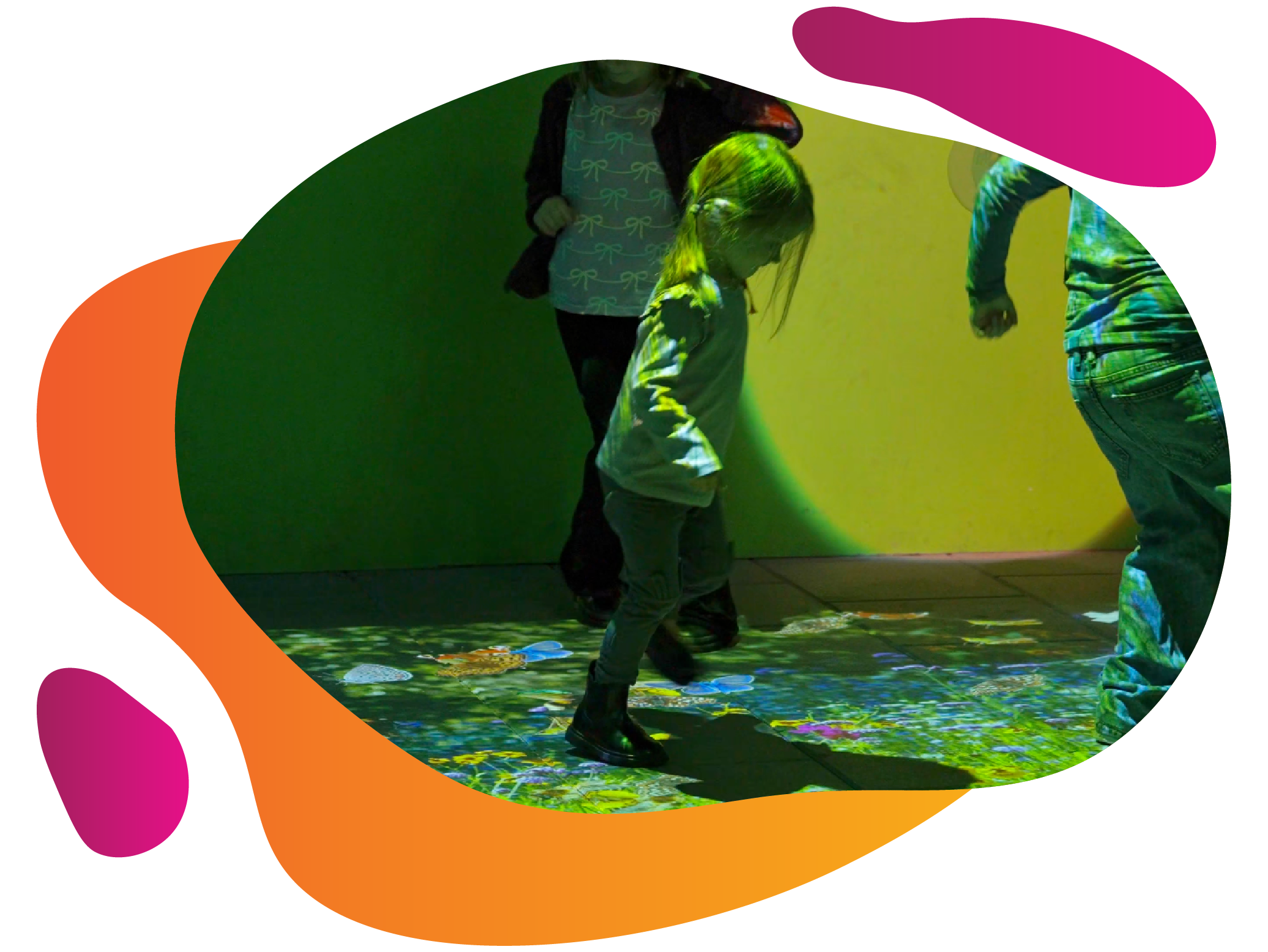
Learning does not happen only through listening, reading, and repetition. Learning is an active process in which children learn by participating, acting, gaining sensory experiences, and interacting with others. It is precisely in this process that ActiveFloor offers unique didactic opportunities: here, children cannot remain passive receivers – they must participate.
There is no learning without the body
When children use ActiveFloor, learning becomes embodied and concrete.
They can spell using their bodies by jumping on letters. They can work with numbers, geography, and other subject areas by moving in a learning space where concepts are not only heard – but also seen and enacted.
Ole highlights three crucial effects of embodied learning:
1) Learning becomes an active action – not passive reception
The concept of “instruction” suggests that knowledge can be poured into children. Instead, learning is described as something that happens when the child is actively engaged in the process. When the body is involved, learning becomes both an action and a form of understanding.
2) Motivation arises because children do not experience it as practice
Ole emphasizes that children often train academic skills without experiencing it as repetition or obligation. They participate in an activity that feels meaningful and fun, while their academic competencies are strengthened at the same time.
3) More children gain access to the subject matter
Children learn in different ways: some remember best what they hear, others what they see. What they have in common is that when the body is activated, the likelihood of learning “sticking” increases – while learning also becomes more inclusive.
Active participation moves children from passive receivers to active creators
Ole challenges a view of schooling where children are expected to acquire knowledge primarily by sitting still and receiving information. That form of teaching may work for some – but not for all.
Here, Ole points to active participation as an important didactic approach, because active participation gives more children a pathway into learning.
On ActiveFloor, children can build, move, test, and create. They can work with language, mathematics, and other subject areas – but also with collaboration, problem-solving, and creative processes. Participation is not only individual; it is often shared, which means social competencies become part of the learning.
Community and social learning become part of teaching
Ole emphasizes that children learn in unique ways by learning from one another. In a shared learning space, children must make room for others, read each other’s actions, and build on one another’s ideas. Non-verbal communication, negotiation, and social interaction emerge naturally – all as part of the learning situation.
Mistakes become safe – and that opens the door to learning
In active learning situations, mistakes are not failures, but part of the process. Children try again, laugh, adjust, and move on. This experience is crucial, because mistakes are a natural part of both learning and life.
Agency and democratic skills are strengthened through action
Ole points out that children develop agency when they act and experience immediate feedback: it works – or it does not. This creates an understanding of the connection between action and consequence, and it trains children to participate actively, collaborate, and think critically.
Active learning is a learning philosophy
Ole’s overall conclusion is that active learning should not be understood as “a fun break” from real teaching. Active learning is a learning philosophy in which knowledge is created through participation: children learn by doing, by being with others – and by using both body and mind in the same process.
In ActiveFloor’s learning environment, participation becomes a prerequisite. And it is precisely this that makes it possible to work simultaneously with academic learning, motivation, inclusion, and community.
Ready for your
own success
story?
Do you have questions, need sparring, or simply want to hear how our interactive learning universe can make a difference for you?
Write to us – we’re always up for a conversation that sparks new ideas.
You won’t be filling out a form that disappears into cyberspace – we respond quickly and personally.
Address:
Helgeshøj Allé 28
2630 Taastrup
Contact & Support:
hello@activefloor.com
+45 31 700 729
Contact us

Vi har set, hvordan læring for alvor sker, når børn leger
Derfor skaber vi interaktive læringsmiljøer, hvor bevægelse, samarbejde og faglighed går hånd i hånd – gjort nemt med vores teknologi.

GET IN TOUCH
ActiveFloor ApS
Helgeshøj Alle 28
2630 Taastrup
hello@activefloor.com
+45 31 700 729
CVR: 36421770
FOLLOW US
QUICK LINKS
- Hjælpecenter
- Support
- Privacy & Cookie Policy
- Terms & Conditions