
Movement-Based Learning and ADHD: Rethinking Inclusion in the Modern Classroom
By Ph.d proffessor Ole Henrik Hansen, Professor of Education
Why Movement May Be One of Education's Most Underutilized Learning Resources
Across schools worldwide, educators are working to create more inclusive learning environments for students with diverse cognitive, social, and emotional needs.
Among the students who often face the greatest challenges within traditional classroom settings are those with ADHD, attention difficulties, executive function deficits, and challenges related to self-regulation.
Historically, educational discussions surrounding these students have focused primarily on behaviour management.
How do we help students remain seated?
How do we reduce disruptions?
How do we increase concentration?
While these questions are understandable, they may not always be the most productive.
From a learning-theoretical perspective, a more important question may be:
“How can learning environments be designed to align more effectively with the way these students learn?”
Increasingly, research within Embodied Learning, Executive Function Theory, and Physically Active Learning suggests that movement may play a far more important educational role than previously assumed.
Rather than viewing movement as a distraction from learning, we may need to begin viewing movement as a mechanism for learning.
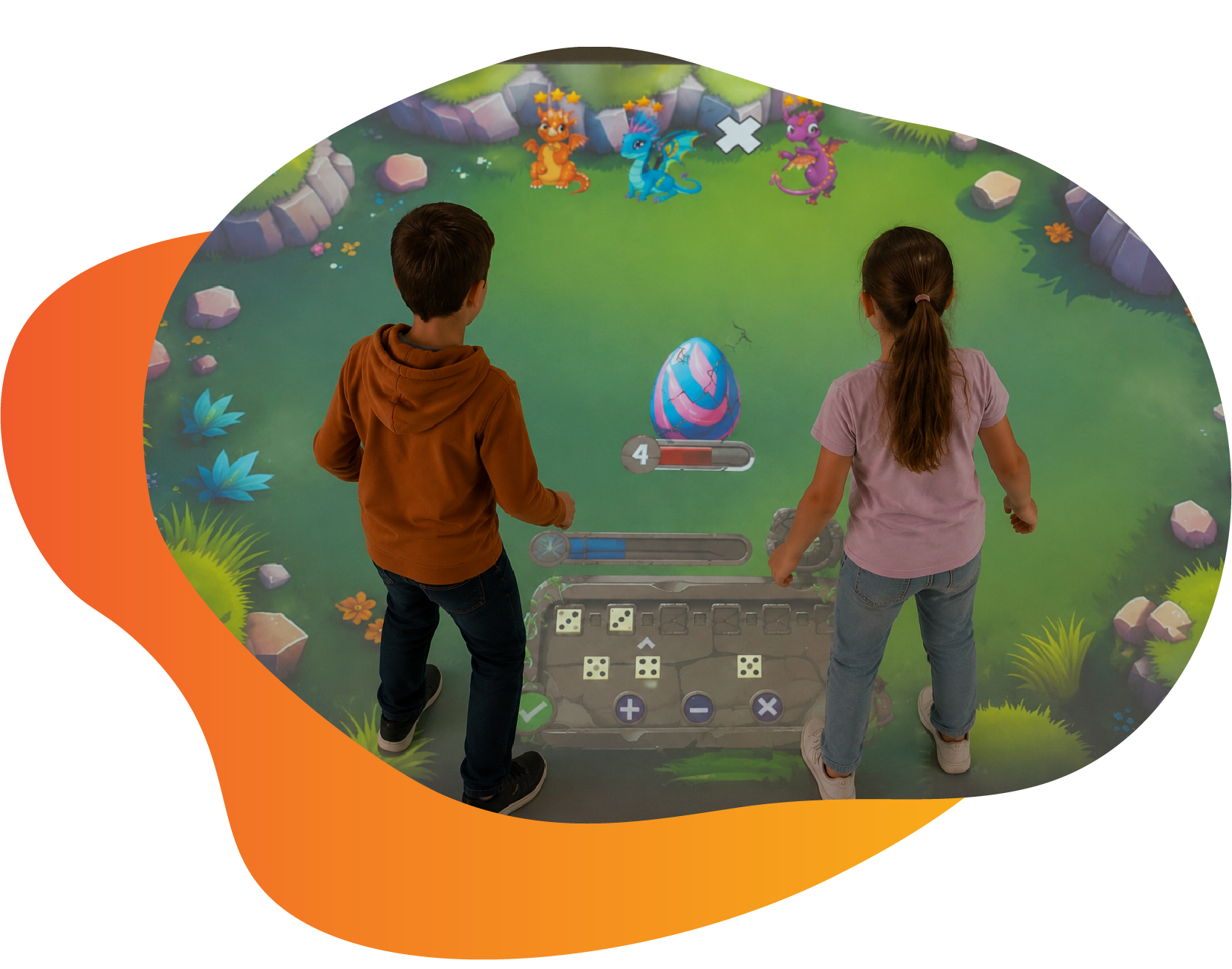
Importantly, modern educational technologies are making it easier than ever to integrate movement into everyday teaching. Interactive learning platforms such as ActiveFloor provide educators with practical ways to combine curriculum content, physical activity, and student engagement in a single learning experience. This is particularly relevant when designing learning environments that support students with ADHD and other attention-related challenges.
Understanding ADHD Beyond Behaviour
ADHD is often associated with visible behaviours such as restlessness, impulsivity, and difficulty sustaining attention.
However, these behaviours are only part of the picture.
At a cognitive level, many students with ADHD experience challenges related to executive functions.
Executive functions can be understood as the brain’s management system.
They support our ability to:
- Sustain attention
- Control impulses
- Organize information
- Follow instructions
- Plan actions
- Regulate behaviour
- Manage working memory
These functions are essential for success in school.
When executive functions are challenged, even relatively simple classroom activities may require considerable cognitive effort.
Importantly, this does not reflect a lack of intelligence or motivation.
Rather, it reflects a mismatch between the demands of the learning environment and the student’s cognitive profile.
Why Traditional Classrooms Can Create Cognitive Barriers
Many classrooms continue to be built around a largely sedentary model of learning.
Students are expected to sit still, maintain attention for extended periods, process information through visual and auditory channels, and suppress their natural need for movement.
For some students, this model works reasonably well.
For others, it creates significant barriers to participation and learning.
Students with ADHD and executive function difficulties often experience higher levels of cognitive fatigue when required to continuously inhibit movement and maintain attention in static learning environments.
In these situations, a substantial portion of the student’s cognitive resources may be devoted to self-regulation rather than learning itself.
As a consequence, academic performance can suffer even when intellectual potential is high.
This raises an important educational challenge: if movement supports attention and self-regulation, should schools continue to design learning environments that minimize movement?
The Relationship Between Movement and Executive Functions
One of the most promising developments within educational research is the growing understanding of how movement influences executive functions.
Research on Physically Active Learning and Exergames suggests that movement-based learning activities can support several cognitive processes that are fundamental to academic success. These include:
Working Memory
Working memory allows students to temporarily store and manipulate information while performing a task.
This ability is critical when solving mathematical problems, reading complex texts, or following multi-step instructions.
Research suggests that movement-based learning activities can strengthen working memory by engaging multiple cognitive systems simultaneously.
Interactive learning technologies such as ActiveFloor can support this process by requiring students to combine physical responses with academic decision-making, thereby activating both cognitive and motor systems during learning.
Sustained Attention
Attention is not a fixed ability. It is influenced by motivation, environmental conditions, cognitive load, and physiological factors.
Movement can help maintain alertness and engagement, making it easier for students to remain focused on learning activities over time.
One reason movement-based technologies have attracted growing interest is their ability to transform passive learners into active participants. When students interact physically with educational content, attention often becomes easier to sustain because learning becomes something they do rather than something they simply receive.
Inhibitory Control
Inhibitory control refers to the ability to pause, reflect, and regulate behaviour before acting.
This skill is particularly relevant for students with ADHD.
Studies indicate that physically active learning environments may contribute positively to the development of inhibitory control and self-regulation.
Many educational games and movement-based activities require students to wait, choose, respond, and adapt their actions according to changing instructions. These are precisely the kinds of executive function processes that schools seek to strengthen.
Rethinking Movement in Education
Traditional educational thinking has often positioned movement as something that occurs before learning, after learning, or during breaks from learning.
Embodied Learning challenges this assumption.
From an embodied perspective, learning is not exclusively a cognitive activity.
Knowledge is constructed through interaction between the mind, the body, and the surrounding environment.
Movement therefore becomes part of the learning process itself.
The educational objective is not simply to increase physical activity.
The objective is to integrate movement into academic instruction in ways that strengthen understanding, memory, and engagement.
This distinction is crucial.
There is a significant difference between allowing students to move and designing learning experiences where movement directly supports learning outcomes.
This is where educational technologies such as ActiveFloor become particularly relevant. Rather than adding movement as an extra activity, the technology enables movement to become an integrated part of academic instruction. Mathematics, language learning, science, and social studies can all be taught through activities where physical interaction directly supports the learning objective.
Movement as an Inclusion Strategy
Inclusion is often discussed in terms of access.
However, genuine inclusion requires more than placing students in the same classroom.
It requires creating learning environments where students can actively participate and succeed.
For students with ADHD and attention challenges, movement-based learning can function as an important inclusion strategy.
Rather than continuously correcting movement, teachers can utilize movement as an educational resource.
Rather than treating physical activity as a behavioural problem, schools can recognize it as a pathway to engagement.
This shift has important implications.
Students who previously struggled within traditional classroom structures often experience greater participation, improved confidence, and increased academic engagement when movement becomes an accepted and valued part of learning.
Interactive learning environments can be especially valuable because they offer multiple entry points into learning. Students who struggle with traditional desk-based instruction may discover new opportunities to demonstrate competence, collaborate with peers, and engage with academic content through movement.
The Importance of Time-on-Task
One of the strongest predictors of learning is the amount of time students spend actively engaged with academic content.
Researchers often refer to this as Time-on-Task.
For students with ADHD, maintaining high levels of Time-on-Task can be particularly challenging within passive learning environments.
Research on Physically Active Learning demonstrates encouraging results.
Several studies have found that movement-integrated instructional approaches can significantly increase student engagement and improve Time-on-Task compared to traditional instruction.
From an educational perspective, this is highly significant.
When students are engaged, learning becomes more likely.
When engagement declines, even the best instructional content may fail to achieve its intended impact.
One reason schools increasingly adopt technologies such as ActiveFloor is precisely because they help maintain engagement over longer periods. By combining movement, play, collaboration, and curriculum content, teachers can create learning experiences that naturally encourage students to remain focused and involved.
Designing Schools for Neurodiverse Learners
As schools continue to prioritize inclusion, it is increasingly important to recognize that students learn in different ways.
Some students learn effectively through listening.
Others learn through observation.
Many learn most effectively through action and interaction.
Movement-based learning acknowledges these differences and provides additional pathways into learning.
This is particularly valuable for neurodiverse learners whose strengths may not always align with traditional classroom expectations.
By integrating movement into teaching, schools create more flexible learning environments that support a wider range of learners without lowering academic expectations.
Educational technologies can play an important role in this transformation. ActiveFloor, for example, allows teachers to adapt activities to different ages, abilities, and learning objectives, making it easier to create differentiated and inclusive learning experiences within the same classroom.
A New Perspective on ADHD and Learning
For many years, educational conversations about ADHD have focused on reducing movement. Current research suggests that a different approach may be more productive. Rather than asking how we can stop students from moving, we should ask how movement can be used to support learning.
When viewed through the lenses of Executive Function Theory, Embodied Learning, and inclusion, movement is no longer a distraction. It becomes a learning resource. For some students, it may even be the key that unlocks participation, engagement, and academic success.
As schools continue to seek evidence-based approaches to inclusion, movement-based learning deserves serious consideration—not as an educational trend, but as a pedagogical strategy grounded in contemporary learning theory and supported by an expanding body of research.
Technologies such as ActiveFloor illustrate how these principles can be translated into everyday educational practice. By combining movement, curriculum content, and interactive learning design, schools gain a practical tool for supporting executive functions, increasing engagement, and creating more inclusive learning environments for all students.
The challenge for educators is therefore no longer whether movement belongs in learning.
The challenge is how effectively we can harness movement as a resource for learning, participation, and inclusion.
About the Author
Dr. Ole Henrik Hansen is Professor at the School of Education and Communication at Jönköping University.
His research focuses on learning theory, inclusion, executive functions, educational technology, and movement-based learning environments.
He advises educational organizations on evidence-based approaches to learning and school development.